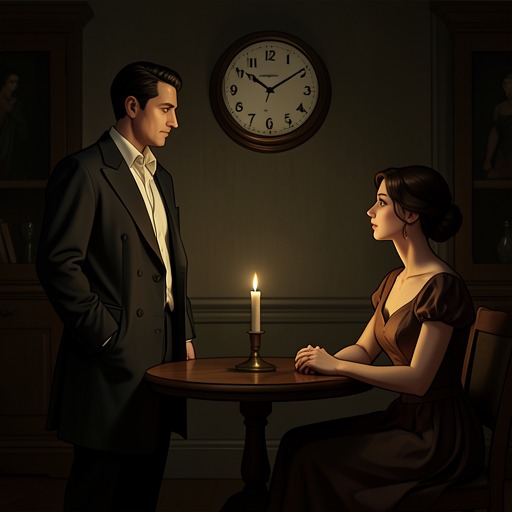
“Your fathers would be so proud”
Just Deserts“Your fathers would be so proud” is Elizabeth Bennet’s pointed rebuke to Fitzwilliam Darcy and the other gentlemen who have permitted Caroline Bingley’s hostile treatment of ladies and guests. Spoken as Elizabeth withdraws from the drawing room, the sentence turns filial pride into an accusation: the men’s fathers would have reason to judge their conduct, not praise it. Its force lies in making masculine reputation answerable to the protection and respect supposedly required of gentlemen.
Immediate Context
The expression belongs to the aftermath of a bitter confrontation at Netherfield Park. Caroline Bingley has behaved toward Elizabeth with what Fitzwilliam Darcy recognizes as inappropriate hostility, yet the three gentlemen present have failed to stop her. Elizabeth, having called Caroline Bingley the Devil, rises and announces that the evening has been enlightening. Her departure is not silent retreat; it is a final judgment on the social company she has just witnessed.
Addressing each of the three gentlemen in turn, Elizabeth says, “It had also been instructive to watch the behaviour of so-called gentlemen. To allow this behaviour to ladies and guests of the house, your fathers would be so proud.” The phrase is therefore inseparable from the preceding contrast between the title of gentleman and the conduct that supposedly validates it. The expression does not merely insult the men. It identifies their passivity as a collective failure and places that failure before the authority of the previous generation.
Rhetorical Structure and Meaning
The sentence is deliberately ironic. “Your fathers would be so proud” appears, on its surface, to offer approval, but the surrounding words make the intended meaning unmistakably condemnatory. Elizabeth invokes paternal pride only to expose the distance between inherited status and earned character. The men possess the social position of gentlemen, yet their unwillingness to intervene has made the title hollow.
Its rhetoric depends on compressed social pressure. Elizabeth does not catalogue every offense or plead for sympathy. Instead, she presents the men with an imagined audience: their fathers. That audience transforms a private embarrassment into a question of lineage, education, and family responsibility. A gentleman’s conduct is represented as something that reflects not only on himself but on the household that formed him.
The expression also carries a gendered challenge. Caroline Bingley’s behavior is directed at women and guests, while the men’s failure is a failure to restrain or answer it. Elizabeth refuses the expectation that a woman should endure such treatment quietly. Her speech gives a woman the authority to define gentlemanliness and to judge men according to their treatment of those with less immediate social power.
Fitzwilliam Darcy’s Private Recognition
The phrase returns in Fitzwilliam Darcy’s reflections after the encounter, where it becomes more than an insult received. Darcy is already in a foul mood and remembers his father’s admonition that when a person is angry at everybody, he should stop and look in the mirror because the real problem will be staring back at him. This private counsel establishes the interpretive key for the expression: moral judgment must begin with self-examination.
Darcy knows that he has tolerated Caroline Bingley’s conduct for the sake of his friendship with Charles Bingley. He has maintained politeness toward Caroline Bingley despite her inappropriate behavior because he wishes to preserve that friendship. At the same time, he has been unpardonably rude to Elizabeth Bennet, a young woman he had only just met. The contrast makes Elizabeth’s rebuke difficult for him to dismiss. He can blame Caroline Bingley for provocation, but he cannot escape the fact that he and the other men failed to prevent the scene.
Darcy’s memory of the sentence becomes especially vivid when he reconstructs the confrontation. He imagines Caroline Bingley arriving at a duel with a sword and Elizabeth arriving with a pistol, shooting Caroline Bingley in the face, reloading, and then turning on the men as “so-called gentlemen.” The violent metaphor dramatizes Elizabeth’s verbal force, but Darcy’s conclusion is more important than the image: Elizabeth should not have needed to respond so fiercely because three gentlemen had failed to act. His father’s frowning face appears in his thoughts, and the rebuke becomes an inward indictment.
Consequences for the Relationships
For Elizabeth, the expression marks a decisive withdrawal from the Netherfield party. She tells Jane Bennet that she will pack her trunk, sleep in Jane’s bed, and leave at first light. The rebuke therefore leads directly into an act of separation. Elizabeth will not remain in a household where women and guests are exposed to behavior that the men present refuse to challenge.
For Darcy, the expression intensifies his conflict between attraction and disapproval. He recognizes Elizabeth’s beauty, figure, intelligence, and reading, but he also struggles to reconcile those qualities with what he considers her ruthless response to Caroline Bingley. His attempt to list Elizabeth’s virtues and then defects breaks down because the deeper truth is that her aggression was provoked by conduct he himself had permitted. The expression thus prevents him from converting the encounter into a simple judgment against Elizabeth.
It also exposes the strain in Darcy’s friendship with Charles Bingley. Darcy has tolerated Caroline Bingley because she is Charles Bingley’s sister, while his reflections suggest that Charles Bingley may likewise lack a firm sense of estate management and responsibility. The phrase consequently broadens from a rebuke of one evening into a measure of the men’s wider obligations: friendship, family privilege, and gentlemanly status cannot excuse neglect of responsibility.
Narrative and Thematic Significance
The expression functions as a compact test of character. Fitzwilliam Darcy’s first reaction to the Meryton Assembly insult is shame, but Elizabeth’s later words show him that his failure is not exhausted by personal rudeness. He has participated in a social structure in which a woman’s misconduct is tolerated because it is convenient to powerful men. The rebuke makes complicity visible.
Its recurrence also links public speech with private conscience. Elizabeth uses the sentence to end an encounter on her own terms; Darcy later carries it into solitude, where it joins his father’s mirror-like admonition. The words therefore move from social performance to moral self-knowledge. What Elizabeth says as a weapon becomes, for Darcy, an instrument of reflection.
The expression’s enduring significance lies in its irony. It asks what kind of pride a family can take in a son who possesses the privileges of a gentleman but abandons the responsibilities attached to them. By making paternal approval sound like condemnation, Elizabeth overturns the assumption that status proves virtue. The phrase leaves Darcy with a standard he cannot comfortably evade: gentlemanly identity must be demonstrated through action, especially when women and guests require protection from the behavior of the socially powerful.